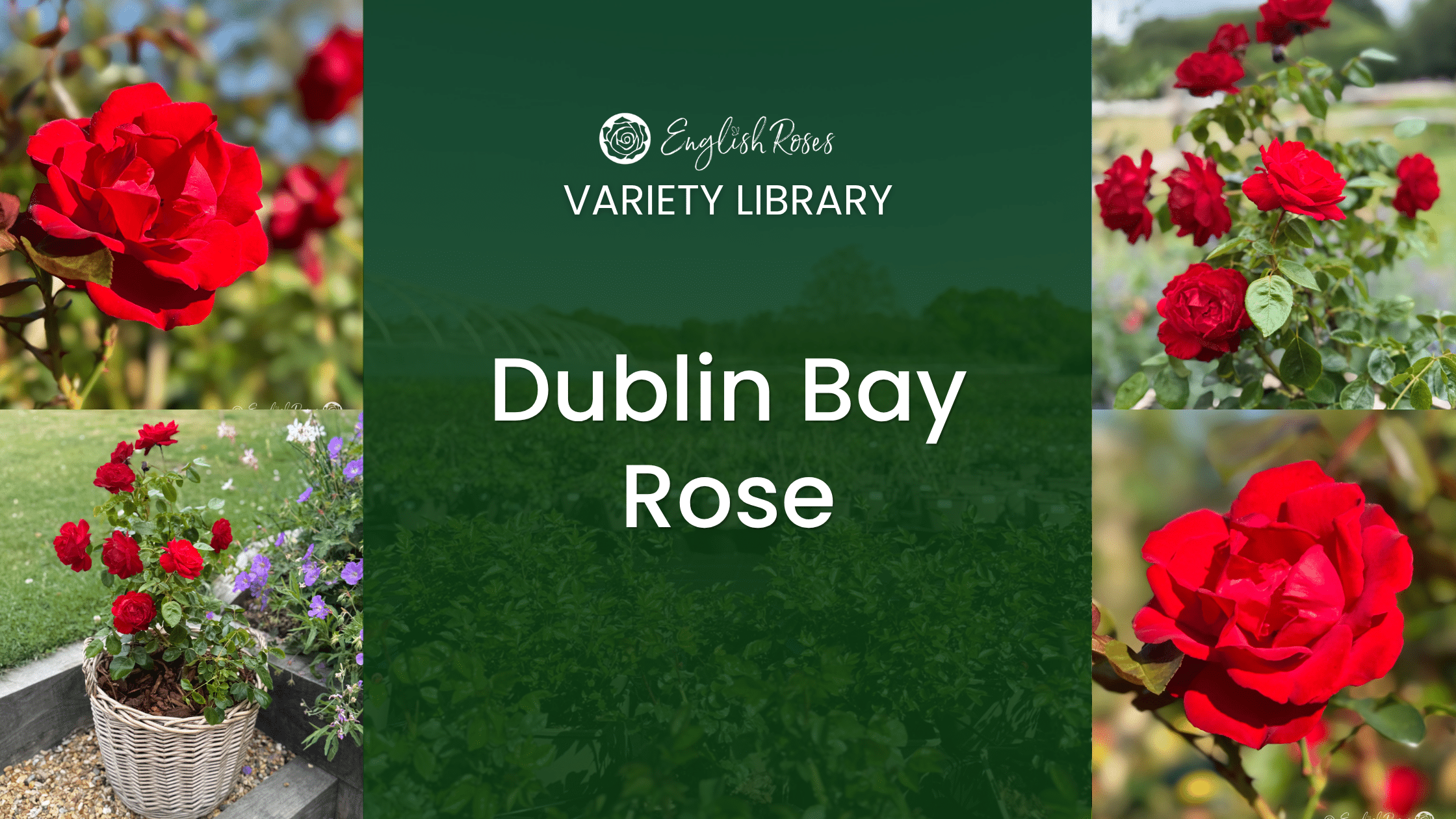
Dublin Bay Rose is a fantastic variety that will climb up medium walls and fences to create a stunning display of sizzling red blooms all summer long. You can purchase Dublin Bay Rose here.
Watch our video to see all about Dublin Bay rose and how this wonderful variety looks in the garden.
Description

| Colour: | Deep velvet red |
| Type: | Floribunda Climber |
| Maximum Height/Width: | 250cm/150cm |
| Foliage: | Glossy green |
| Habit: | Vigorous, upright climber with strong and sturdy stems. Compact for a climber. |
| Petal and Form: | 25 petals. Large double blooms. |
| Blooming Period: | Summer to early autumn |
| Fragrance Profile: | Strength – Very mild Primary Scent – Fruity (barely detectable) Nuance – None |
Photos
Taken here at English Roses, we have a selection of photographs showcasing Dublin Bay rose in all its beauty.
Fragrance Profile

A very mild scent with a slightly fruity note.
Strength – Very mild
Primary Scent – Fruity (barely detectable)
Nuance – None

Nomenclature and Classification

| Botanical Name: | Dublin Bay |
| Also Known As: | |
| Breeder Code: | MACdub |
| Group / Class: | Floribunda Climber |
| Breeder: | Samuel McGredy IV |
| Parentage: | Bantry Bay X Altissimo |
| Introduced by: | Samuel McGredy and Son 1969 |
| Origin: | New Zealand |
| Distribution: | Widely distributed. English Roses supply rose gifts including Dublin Bay in the UK. |
| Awards: | The Hague Gold Medal 1977, New Zealand Rose Trials Best Climber 1992, RHS Award of Garden Merit 1993 |
History and Development
The McGredy’s began breeding roses in Portadown County Armagh in 1895. The fourth Samuel McGredy (1931 – 2019) took over the business in 1952. Despite being largely ignorant of rose breeding he gained knowledge and experience via notable contemporary breeders such as Reimer Kordes and Niels Poulsen. By the 1960s he had become known for his hybrid tea and floribunda roses such as Orangeade. Deterred by increasing political violence he moved to New Zealand where he bred Dublin Bay Rose.
Requirements and Maintenance

Soil
Flourishes in most soils and is tolerant of slightly acid, neutral or alkaline soils.
Read our planting guide here.
Toxicity
None reported.
Hardiness
RHS rating of H6 indicating a minimum temperature range of -15C to -20C.
Diseases and Pests
Good disease resistance.Be vigilant for the most common diseases such as powdery mildew and black spot. Signs of insects such as aphids and mites should also be monitored.
Treat mildew by pruning affected leaves.
Treat aphids by growing plants that attract insects that prey on aphids. See companion plants below.
Treat blackspot by pruning affected leaves, destroying fallen leaves.
We do not recommend using chemical fungicides as they risk reducing soil health and negatively affecting biodiversity.
See our help guides for more details.
Position
Sheltered or exposed in full sun.
Read our planting guide here.
Cut Flowers
Not especially suitable for cut indoor flowers.
Read our ‘How to Cut a Rose For Display’ guide here.
Watering
Keep the soil consistently moist, especially during the growing season. Water at the base of the plant to prevent fungal diseases.
Read our watering guide here.
Feeding
Slow-release feed early in the season followed by foliar feed during the growing period. Read our feeding guide here.
A granular, slow release feed such as English Roses Protect & Grow Slow Release Rose Feed supports all round health, and nutrients are released steadily over the course of a few months. Combine this with a foliar feed such as English Roses Protect & Grow Rose Foliar Feed in the summer months, for a quick burst of nutrients that encourage beautiful blooms.
Pruning
Hard prune in February or March. Regular deadheading during the season promotes new growth. See our pruning guide here.
Propagation
By hardwood cuttings in Autumn or chip budding in summer.
Rose Care Help Guides
Would you like more information about caring for your roses? Read our handy how-to guides and other rose care information from our expert Rose Care Team.


Companion Planting
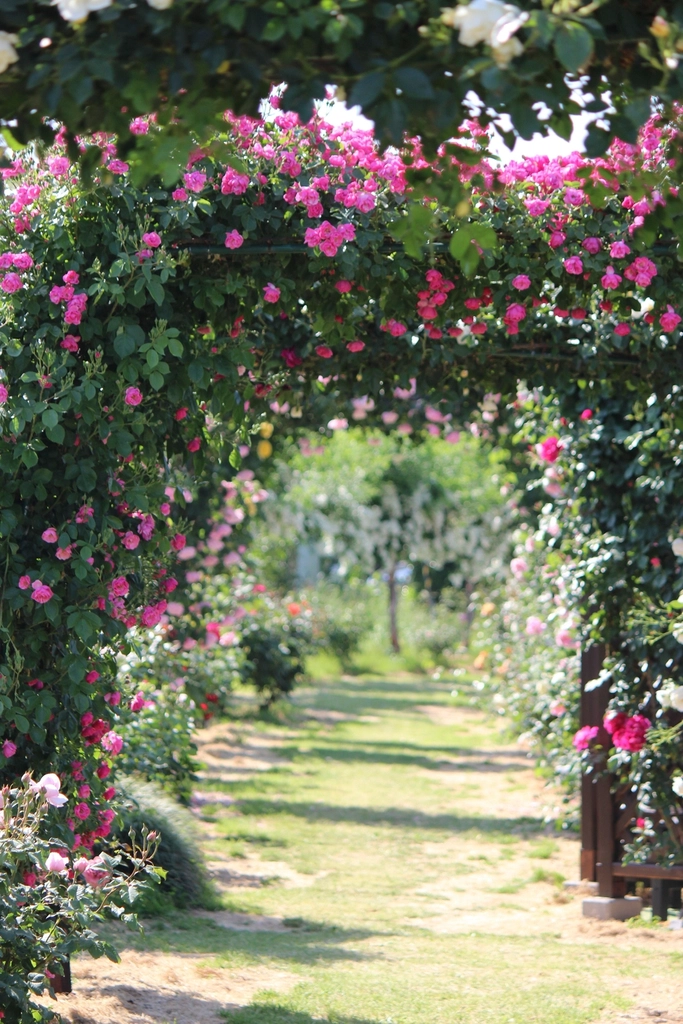
The first step is to choose plants that share similar requirements in terms of soil, fertilizer, water and sun exposure. Be mindful of prolific plants that may compete with your roses.
You may wish to avoid plants that attract aphids such as cosmos, nasturtiums and sunflowers although they can also act as a lure to draw pests away from your roses.
Consider plants that attract insects that feed on aphids. Lacewings, ladybirds and hoverflies are predatory insects that eat pests. The Seedball Beetle mix is perfect for attracting ladybirds to your roses.
Plants such as alliums, lavender and geraniums possess strong scents that repel pests.
Planting the likes of catmint and marigolds you encourage a natural ecosystem beneficial to your roses. Catmint is also a good pollinator and provides attractive ground cover. A lower growing marigold such as French or Signet performs a similar task and delivers a colourful carpet around your roses.
Consider plants that will offer colour into the autumn such as salvias and verbenum.
Complementary Colours
The rich red tones of Dublin Bay will contrast beautifully with whites and creams. Late flowering clematis growing through the rose will extend your flowering season. Honeysuckle shares similar growth habits. Their sweet scent will make up for Dublin Bay’s negligible fragrance.
Complementary Roses
As a climbing rose with vibrant blooms, Dublin Bay would look great as the main centrepiece when framed by bush roses. The green foliage naturally provides the complement to the red flowers, but planting cream roses alongside would make the red really pop and elevate the whole display.
-

Timeless Cream Rose
Add to Basket£31.99 -
Champagne Moment Rose
Add to Basket£31.99 -
Ruby Wishes Rose
Add to Basket£29.99 -
White Patio Rose
Add to Basket£31.99 -
Precious Ruby Rose
Add to Basket£31.99


Reviews
English Roses Recommends
Hear what our experts at English Roses have to say about Dublin Bay rose:
- “This is such a lovely rambling climber. I’ve always loved red roses and I have this one scrambling up an arched pergola. It nearly made it to the top in just a year!” – Sarah, Rose Care Team at English Roses
Customer Reviews
See what our lovely customers say about Dublin Bay rose:


Where to Buy Dublin Bay Rose
Dublin Bay Rose
With its striking large red blooms, this beautiful climber is sure to brighten up any garden space. Dublin Bay Rose is a fantastic variety that will climb up medium walls and fences to create a stunning display all summer long. Mildly scented with scarlet-crimson petals, this majestic rose is sure to be a firm favourite. Eco-friendly and long lasting, Dublin Bay rose would make a wonderful addition to a garden space.
English Roses Variety Library
View more complete guides to your favourite roses. We have created lots of resources containing everything you need to know about each variety including variety specifications, history and care information.


Resources:
- rosehomegarden.com
- rhs.org.uk
- helpmefind.com
- pithandvigor.com
- wikipedia.com
- gardendesign.com
- rosesuk.com
- garden.org
Keep in Touch!
Be sure to sign up for our free newsletter for the to be kept up to date with the latest news, exclusive offers, and top tips from our expert Rose Care Team.
Follow us on Facebook, Instagram and also TikTok and join us in spreading the joy of roses!